"Rare clarity of thought… impactful for anyone trying to learn physics."
— Ashish Shekhar, Head of Content, Khan Academy
AP PHYSICS 1: EQUATIONS & TRAPS
The Complete Equation Reference — All 8 Units
Knowing the equation isn't the problem. Knowing when it applies — and catching the exact mistake that costs you the point — is what separates a 4 from a 5.
Every AP Physics 1 FRQ has a version of the same trap built in: the right-looking equation used in the wrong condition. v₀ instead of v₀sinθ for max height. Doubling tₚₑₐₖ on uneven ground. Reporting only vₓ at landing. These aren't obscure edge cases — they're the exact errors College Board's own scoring guidelines flag as the most common ways students lose points.
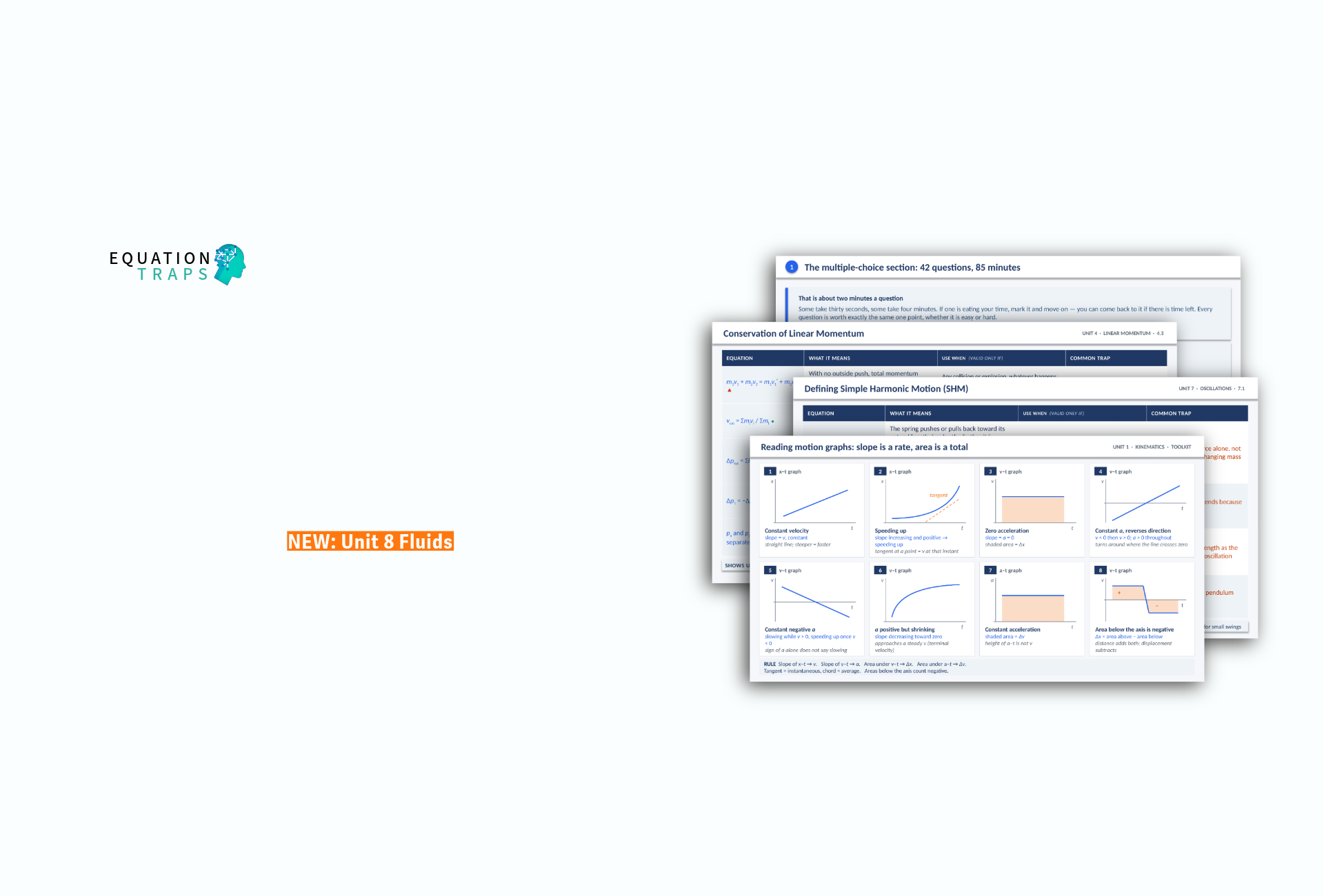
This deck is built around that one insight. Every topic gets four things, side by side: the equation, what it actually means physically, the exact condition it's valid under, and the specific mistakes students fall into when they skip that condition.
What Makes This Different
- Every Equation, Paired With Its Trap. Not just the formula — the exact way it gets misapplied on real FRQs, called out in its own column so you can't miss it.
- Validity Conditions, Not Just Equations. H = (v₀sinθ)²/(2g) only works for a straight-up throw. Δx = v₀t only works for a horizontal launch. Every equation states exactly when it applies and when it breaks.
- Per-Unit Toolkit. Beyond the equation tables, each unit includes a quick-reference for which equation to reach for, how to read the relevant graphs, and the mistakes worth double-checking before you submit.
- Pure Algebra. Strictly aligned to the current College Board AP Physics 1 curriculum — no calculus, no material outside what's actually tested.
- The students who catch these traps in practice are the ones who don't lose them on test day
The Curriculum — All 8 Units
Unit 1: Kinematics — 1D and 2D motion, projectile paths, motion graphs, and the launch-angle traps that show up on nearly every FRQ.
Unit 2: Force & Translational Dynamics — Newton's laws, free-body diagrams, friction, and the net-force sign errors that quietly break an otherwise-correct answer.
Unit 3: Work, Energy & Power — the work-energy theorem, conservation of energy, and power — including when "conserved" secretly isn't.
Unit 4: Linear Momentum — impulse, conservation of momentum, and elastic vs. inelastic collisions.
Unit 5: Torque & Rotational Dynamics — torque, rotational equilibrium, and moment of inertia.
Unit 6: Energy & Momentum of Rotating Systems — rotational kinetic energy, angular momentum, and rolling motion.
Unit 7: Oscillations — simple harmonic motion, springs, pendulums, and energy exchange in oscillating systems.
Unit 8: Fluids — density, pressure, buoyancy, continuity, and Bernoulli's equation.
Plus: Exam Technique. A dedicated 9-page guide on how to actually earn points on FRQs — not just what to know, but how to write it so the scorer gives you credit for it.
How to Use This
- Pre-Exam Review. Work through all 8 units a week or two out to catch every trap before it costs you on test day.
- FRQ Practice. Keep the relevant unit open while you work practice problems — check your answer against the validity condition, not just the equation.
-
Quick Lookup. 10 separate PDFs — the 8 units, the Exam Technique guide, and one full compiled deck with everything in one file — means you're never scrolling through 140 slides to find one equation. Grab the unit you need and go.
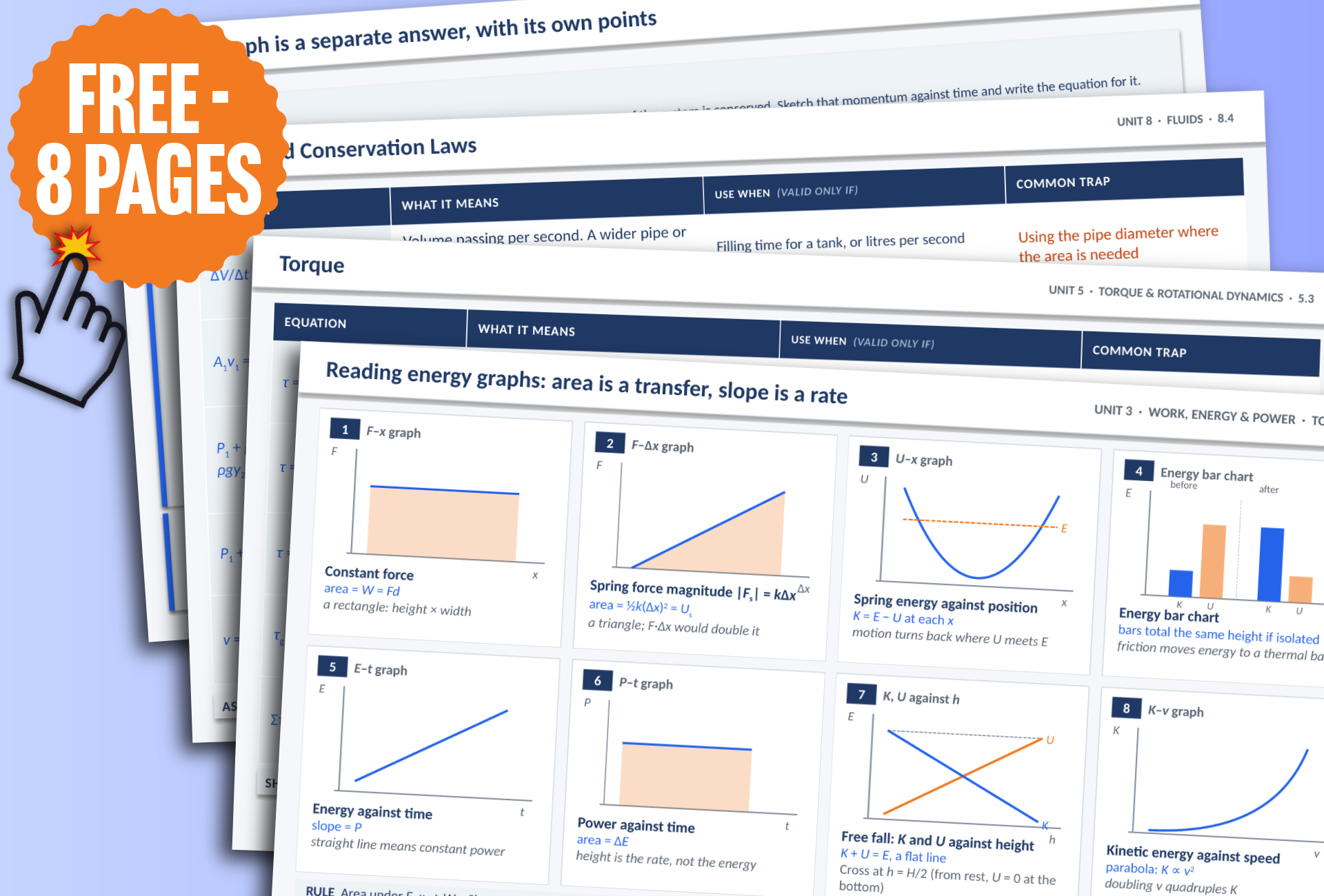
These are real pages, not mock-ups
Eight pages from the deck, exactly as they appear in the PDF you’ll download — same layout, same typography, nothing redrawn to look good on a sales page.
They’re pulled from across the units, so you can see how the format holds up on torque, on energy graphs, on fluids and on exam technique.
Get the free 8-page pack — Instant access, no card required
FAQs
Can I see it before I buy?
Yes. The free sample pack has real pages pulled from across the deck plus the Exam Technique guide — the same pages you'd get in the full version, not a teaser.
What exactly do I get?
Ten PDFs: one per unit (8), the 9-page Exam Technique guide, and one compiled file with all 140 pages in a single document for searching.
Is this the current curriculum?
Yes — it's built against the current College Board AP Physics 1 framework, all 8 units including Fluids. Pure algebra, no calculus, nothing outside what's tested.
Can I print it?
Yes. The pages are designed landscape, so they print cleanly two-up or one per sheet. Print the units you're working on and keep the rest on your phone.
Does it work on a phone?
Yes. The tables are built to be read on a screen — keep the unit open beside your problem set.
Do I still need a prep book?
Probably, and that's the point. This isn't a practice-test book. It's the reference you keep open while you work problems — the one that tells you when an equation applies and how it gets misused. Use it alongside whatever practice material you already have.
Will I get updates?
Yes, free, forever. Unit 8 Fluids was added after launch and existing buyers got it at no cost. Anything I add later reaches you the same way.